FORTHCOMING JULY 2026:
The Poems of Catullus: A Dual-Language Edition with Parallel Text. Penguin Classics, 2026. (Translation, with Introduction and Notes).
PREVIOUS BOOKS:
Women in Power: Classical Myths and Stories, from the Amazons to Cleopatra. Penguin Classics, 2024. (Editor, with introduction and translated selections).
Praise:
“By reconstructing diverse episodes—mythical, legendary, and historical—in which women exercised power, Stephanie McCarter ultimately helps to illuminate the reasons and circumstances that led to the exclusion of women from power in classical antiquity. Moreover, her study can offer us answers to the reasons why power continues to be associated with masculinity in the minds of so many, including women themselves.” (Francesca Rohr, Bryn Mawr Classical Review)
“Not all Greek and Roman women were downtrodden – though the truth is that most were. It is a refreshing change to read a collection of vivid ancient texts that tell of powerful women, some legendary, some real. These stories can be two-edged, though: a lot of these women in power make a mess of things, so prove exactly why (for ancient men) women should not be running the world.” (Mary Beard, BBC History Magazine, 2024 Books of the Year).
The community effort of translators that went into this anthology pays off – with a thorough scope, a great introduction essay, and super helpful notes throughout. I can see this being super helpful in structuring a class about ancient women or ancient literature, and a great jumping board for anyone trying to get into ancient femininity but doesn’t know where to start. (Mac Chamberlain, The Southern Bookseller Review)
Ovid: Metamorphoses. Penguin Classics, 2022. (Translation, with Introduction and Notes).
Winner of the Harold Morton Landon Translation Award from the Academy of American Poets
Praise:
“The true brilliance, that is, the true reading, the accessibility, of McCarter’s tapestry lies in her use of poetic form.(…) Throughout, McCarter produces gorgeous basso continuo undertones juxtaposed against sharp and high-pitched rhymes. Such formal elements of the translation ultimately represent McCarter’s interpretation of Metamorphoses and the art of translation itself—that humble human craft that has the capacity to stand against and despite the will of gods, power, and time. McCarter has produced her own masterpiece that ‘Jove’s wrath cannot / destroy, nor flame, nor steel, nor gnawing time.’ ‘My name,’ she writes, ‘can’t be erased.’” (Anna Deeny Morales, citation for the 2023 Harold Morton Landon Translation Award from the Academy of American Poets)
“The best translation of a work of ancient literature that I read this year was Stephanie McCarter’s marvellous new translation of Ovid’s Metamorphoses, in fresh, readable, vivid iambic pentameter (Penguin Classics). McCarter captures Ovid’s wit and cleverness, making us laugh at the escapades of abusive, lust-crazed, arrogant gods and hapless, also lust-crazed and arrogant mortals. But she also brilliantly evokes Ovid’s more serious sides, including his attentiveness to power and the magical vivacity of the natural world. Her wonderful handling of metrical poetic form is a fitting match for Ovid’s artful, fluent Latin verse.” (Emily Wilson, The New Statesman‘s “Books of the year 2023”)
“Stephanie McCarter’s translation offers an attractive alternative to the finest versions to appear in recent decades, while the abundance of her introductory and explanatory material gives her work a clear advantage over those predecessors. As a vehicle for serious engagement with Ovid’s poem in English, McCarter has no rival.” (Richard Tarrant, Bryn Mawr Classical Review)
“Stephanie McCarter’s gorgeous verse translation of the Metamorphoses is ground-breaking not just in its refreshingly accessible approach to Ovid’s syntax and formal devices, but for how she reframes the controversial subjects that have made Ovid, and Ovidian scholarship, so fraught for contemporary readers. McCarter’s translation understands that the Metamorphoses is a complex study of power and desire, and the dehumanizing ways that power asserts itself through and on a variety of bodies. McCarter’s deft, musical, and forthright translation returns much-needed nuance to Ovid’s tropes of violence and change, demonstrating to a new generation of readers how our identities are always in flux, while reminding us all of the Metamorphoses’ enduring relevance.” (Paisley Rekdal, author of Nightingale)
“The Metamorphoses has it all: sex, death, love, violence, gods, mortals, monsters, nymphs, all the great forces, human and natural. With this vital new translation, Stephanie McCarter has not only updated Ovid’s epic of transformation for the modern ear or era — she’s done something far more powerful. She’s paid rigorous attention to the language of the original and brought to us its ferocity, its sensuality, its beauty, its wit, showing us how we are changed, by time, by violence, by love, by stories, and especially by power. Here is Ovid, in McCarter’s masterful hands, refreshed, renewed, and pulsing with life.” (Nina MacLaughlin, author of Wake, Siren: Ovid Resung)
“McCarter confronts the tricky issues associated with both the poet and his epic not only in her forthright introduction but in the translation itself, where, like an art restorer removing decades of browned varnish from an Old Master, she strips away a number of inaccuracies and embellishments that have accreted in translations over the decades and centuries, obscuring the sense of certain passages, particularly those portraying women and sexual violence.” (Daniel Mendelsohn, The New Yorker)
“McCarter adroitly captures Ovid’s glittering darkness. There is horror here but there is also so much wonder and delight, all conveyed in nimble, fresh language.” (Kamila Shamsie, author of Home Fire)
“A graceful and fluid and deeply meaningful translation. Compared to the other translations of the Metamorphoses on which I’ve relied in the past, it’s as though this is of an entirely different book. The reader follows the lines with genuine emotion. And so do worlds open up—” (Alexander Nemerov, Carl and Marilynn Thoma Provostial Professor in the Arts and Humanities, Stanford University)
“McCarter’s excellent poetic instincts and thorough understanding of the text makes this a timely and invaluable contribution to classical and poetic scholarship.” (Publisher’s Weekly)
“Stephanie McCarter’s translation is lush and gorgeous, keeping the poetic bones of Ovid’s epic without falling into the clunky pitfalls that come from translating a classic poem to English. McCarter takes a frank look at the power dynamics of the Metamorphoses, making this the perfect companion to Emily Wilson’s The Odyssey and Caroline Alexander’s The Iliad.” (Boston Magazine, “25 Books Boston Booksellers Are Looking Forward to This Fall“)
“The result of her spare approach is nothing short of classic …. Ms. McCarter’s “Metamorphoses” is not a crib or a pony on Ovid’s Latin; nor is it an original work with vaguely Ovidian window-dressing …. Rather, it is what its title proclaims — a transformation of Ovid’s fluid Latin into Ms. McCarter’s taut English, something new and distinct in form but, still, under it all, the same.” (Jude Russo, The New York Sun)
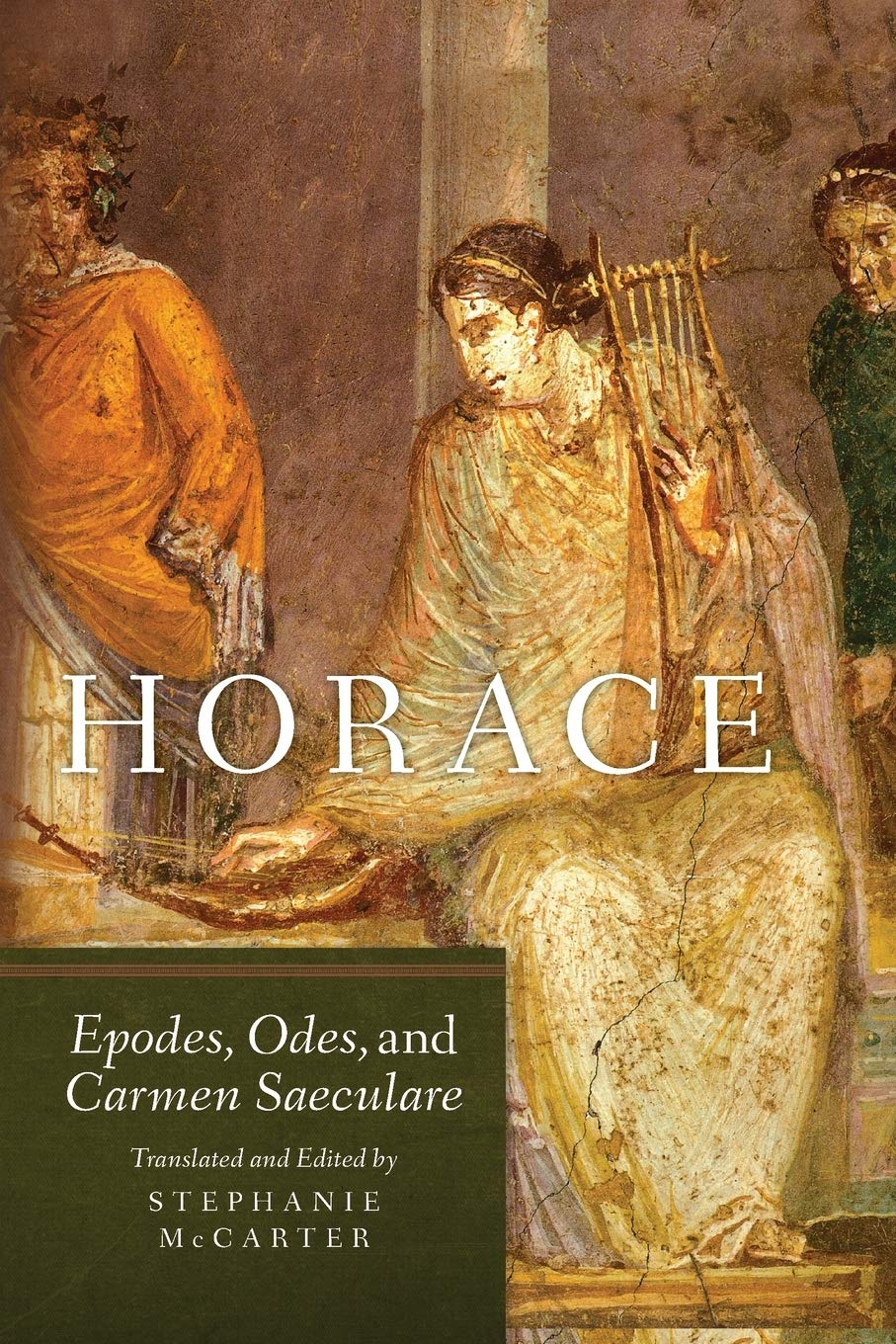
Horace: Epodes, Odes, and Carmen Saeculare. The University of Oklahoma Press (Norman, 2020). (Translation, with Introduction and Notes)
Praise:
“Stephanie McCarter’s new translation…of the Epodes and Odes would make an excellent foundation for a course in Horace in translation …. McCarter is, to my knowledge, the first woman to translate all of Horace’s Odes into English. Her approaches to, and reading of, the Odes is, of course, colored by her gender, just as gender influenced the approach and reading of generation upon generation of male translators. Some readers will balk. This reader was delighted …. This handsome volume is, in short, a welcome addition not only to available translations in English of Horace’s lyric genres but promises as well to re-engage students with the work of one of Rome’s most important poets.” (Jeanne Marie Neumann, Exemplaria Classica)
“The translation is superb. It manages to translate every word of the Latin without extending the length of the poems and some of her renderings are simply brilliant….a masterpiece of style and accuracy.” (John Godwin, Bryn Mawr Classical Review)
“[T]his is a successful and compelling volume of translations and the various notes, circumspect introduction and glossary of rhetorical and literary terms will be of especial use to non-Classicist students, teachers and scholars. (Christopher Trinacty, Classical Journal)
“Over the centuries the sophisticated Latin lyrics of the Roman poet Horace…have been translated into English by a procession of literary icons. Thus, any new English version inevitably bears the onus of comparison with its predecessors, both remote and contemporary. In that context this volume deserves kudos and is a welcome addition to the corpus of Horatian poetry transformed into English….In short, this accessible collection of Horace’s work removes…all obstacles to entry into the Horatian poetic universe.” (J.S. Louzonis, Choice)
“For instructors, students and all manner of general readers McCarter’s fine edition would be a worthy investment, whose combination of a faithful, effective translation with especially robust scholarly annotation sets it apart from other English iterations of Horatian lyric.” (Tedd A. Wimperis, The Classical Review)
“Excellent translation in contemporary idiom.” (Louis J. Kern, The Key Reporter)
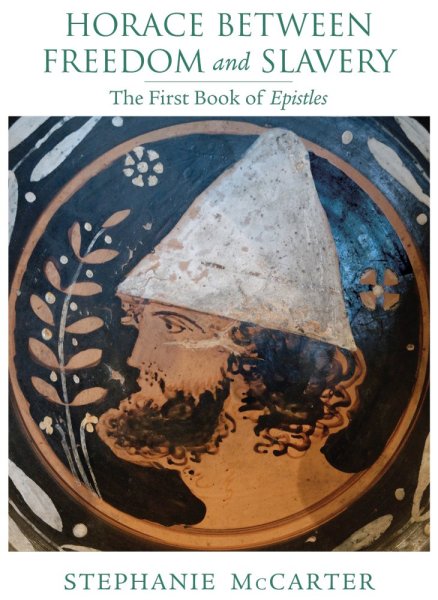
Horace between Freedom and Slavery: The First Book of Epistles. University of Wisconsin Press (Madison, 2015). (Monograph)
Praise:
“McCarter’s unpacking of Horace’s philosophical thinking is a significant contribution to understanding his work and to the broader cultural picture of Roman engagement with Greek philosophical ideas and practices.” (Catherine Connors, University of Washington)
“This delightful book…would be a very valuable companion for anyone reading or studying the Epistles….Definitely a Best Buy.” (Colin McDonald, Classics for All)
“McCarter’s book is a very good contribution to Horatian studies and will be of great help both to the specialist (particularly interpreters and commentators) and to general readers interested in an up-to-date and reliable introduction to the Epistles.” (Andrea Cucchiarelli, American Journal of Philology)
“This is a very good and pleasant book, which offers a strong and consistent interpretation of a book of poetry as a whole.” (Francesco Ursini, Phoenix)
 Stephanie McCarter